

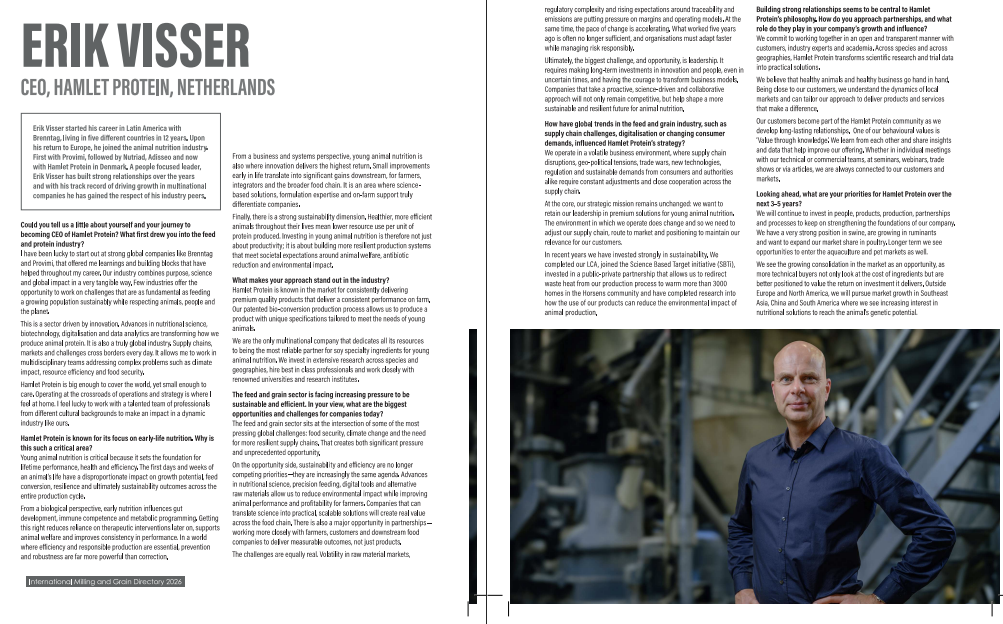
Erik Visser started his career in Latin America with Brenntag, living in five different countries in 12 years. Upon his return to Europe, he joined the animal nutrition industry. First with Provimi, followed by Nutriad, Adisseo and now with Hamlet Protein in Denmark. A people focused leader, Erik Visser has built strong relationships over the years and with his track record of driving growth in multinational companies he has gained the respect of his industry peers.
Could you tell us a little about yourself and your journey to becoming CEO of Hamlet Protein?
What first drew you into the feed and protein industry? I have been lucky to start out at strong global companies like Brenntag and Provimi, that offered me learnings and building blocks that have helped throughout my career. Our industry combines purpose, science and global impact in a very tangible way. Few industries offer the opportunity to work on challenges that are as fundamental as feeding a growing population sustainably while respecting animals, people and the planet. This is a sector driven by innovation. Advances in nutritional science, biotechnology, digitalisation and data analytics are transforming how we produce animal protein. It is also a truly global industry. Supply chains, markets and challenges cross borders every day. It allows me to work in multidisciplinary teams addressing complex problems such as climate impact, resource efficiency and food security. Hamlet Protein is big enough to cover the world, yet small enough to care. Operating at the crossroads of operations and strategy is where I feel at home. I feel lucky to work with a talented team of professionals from different cultural backgrounds to make an impact in a dynamic industry like ours. Hamlet Protein is known for its focus on early-life nutrition. Why is this such a critical area? Young animal nutrition is critical because it sets the foundation for lifetime performance, health and efficiency. The first days and weeks of an animal’s life have a disproportionate impact on growth potential, feed conversion, resilience and ultimately sustainability outcomes across the entire production cycle. From a biological perspective, early nutrition influences gut development, immune competence and metabolic programming. Getting this right reduces reliance on therapeutic interventions later on, supports animal welfare and improves consistency in performance. In a world where efficiency and responsible production are essential, prevention and robustness are far more powerful than correction.
From a business and systems perspective, young animal nutrition is also where innovation delivers the highest return. Small improvements early in life translate into significant gains downstream, for farmers, integrators and the broader food chain. It is an area where science[1]based solutions, formulation expertise and on-farm support truly differentiate companies. Finally, there is a strong sustainability dimension. Healthier, more efficient animals throughout their lives mean lower resource use per unit of protein produced. Investing in young animal nutrition is therefore not just about productivity; it is about building more resilient production systems that meet societal expectations around animal welfare, antibiotic reduction and environmental impact. What makes your approach stand out in the industry? Hamlet Protein is known in the market for consistently delivering premium quality products that deliver a consistent performance on farm. Our patented bio-conversion production process allows us to produce a product with unique specifications tailored to meet the needs of young animals. We are the only multinational company that dedicates all its resources to being the most reliable partner for soy specialty ingredients for young animal nutrition. We invest in extensive research across species and geographies, hire best in class professionals and work closely with renowned universities and research institutes. The feed and grain sector is facing increasing pressure to be sustainable and efficient. In your view, what are the biggest opportunities and challenges for companies today? The feed and grain sector sits at the intersection of some of the most pressing global challenges: food security, climate change and the need for more resilient supply chains. That creates both significant pressure and unprecedented opportunity. On the opportunity side, sustainability and efficiency are no longer competing priorities—they are increasingly the same agenda. Advances in nutritional science, precision feeding, digital tools and alternative raw materials allow us to reduce environmental impact while improving animal performance and profitability for farmers. Companies that can translate science into practical, scalable solutions will create real value across the food chain. There is also a major opportunity in partnerships— working more closely with farmers, customers and downstream food companies to deliver measurable outcomes, not just products. The challenges are equally real. Volatility in raw material markets, regulatory complexity and rising expectations around traceability and emissions are putting pressure on margins and operating models. At the same time, the pace of change is accelerating. What worked five years ago is often no longer sufficient, and organisations must adapt faster while managing risk responsibly. Ultimately, the biggest challenge, and opportunity, is leadership. It requires making long-term investments in innovation and people, even in uncertain times, and having the courage to transform business models. Companies that take a proactive, science-driven and collaborative approach will not only remain competitive, but help shape a more sustainable and resilient future for animal nutrition.
How have global trends in the feed and grain industry, such as supply chain challenges, digitalisation or changing consumer demands, influenced Hamlet Protein’s strategy?
We operate in a volatile business environment, where supply chain disruptions, geo-political tensions, trade wars, new technologies, regulation and sustainable demands from consumers and authorities alike require constant adjustments and close cooperation across the supply chain. At the core, our strategic mission remains unchanged: we want to retain our leadership in premium solutions for young animal nutrition. The environment in which we operate does change and so we need to adjust our supply chain, route to market and positioning to maintain our relevance for our customers. In recent years we have invested strongly in sustainability. We completed our LCA, joined the Science Based Target initiative (SBTi), invested in a public-private partnership that allows us to redirect waste heat from our production process to warm more than 3000 homes in the Horsens community and have completed research into how the use of our products can reduce the environmental impact of animal production.
Building strong relationships seems to be central to Hamlet Protein’s philosophy. How do you approach partnerships, and what role do they play in your company’s growth and influence?
We commit to working together in an open and transparent manner with customers, industry experts and academia. Across species and across geographies, Hamlet Protein transforms scientific research and trial data into practical solutions. We believe that healthy animals and healthy business go hand in hand. Being close to our customers, we understand the dynamics of local markets and can tailor our approach to deliver products and services that make a difference. Our customers become part of the Hamlet Protein community as we develop long-lasting relationships. One of our behavioural values is ‘Value through knowledge.’ We learn from each other and share insights and data that help improve our offering. Whether in individual meetings with our technical or commercial teams, at seminars, webinars, trade shows or via articles, we are always connected to our customers and markets. Looking ahead, what are your priorities for Hamlet Protein over the next 3–5 years? We will continue to invest in people, products, production, partnerships and processes to keep on strengthening the foundations of our company. We have a very strong position in swine, are growing in ruminants and want to expand our market share in poultry. Longer term we see opportunities to enter the aquaculture and pet markets as well. We see the growing consolidation in the market as an opportunity, as more technical buyers not only look at the cost of ingredients but are better positioned to value the return on investment it delivers. Outside Europe and North America, we will pursue market growth in Southeast Asia, China and South America where we see increasing interest in nutritional solutions to reach the animal’s genetic potential.