

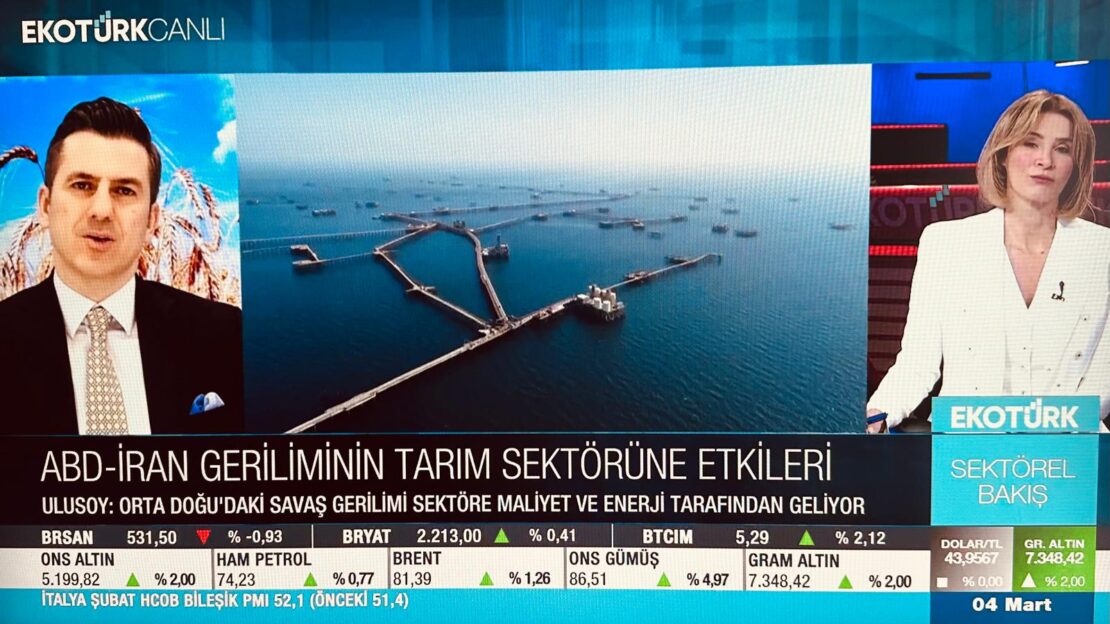

IAOM Eurasia Director Dr. Eren Günhan Ulusoy evaluated the impact of recent geopolitical developments on agricultural and grain markets. Speaking on a programme broadcast on Ekotürk TV and answering questions from journalist Ahu Tanrıkulu, he emphasised that the effects of the latest conflicts on grain markets differ from those seen in previous crises.
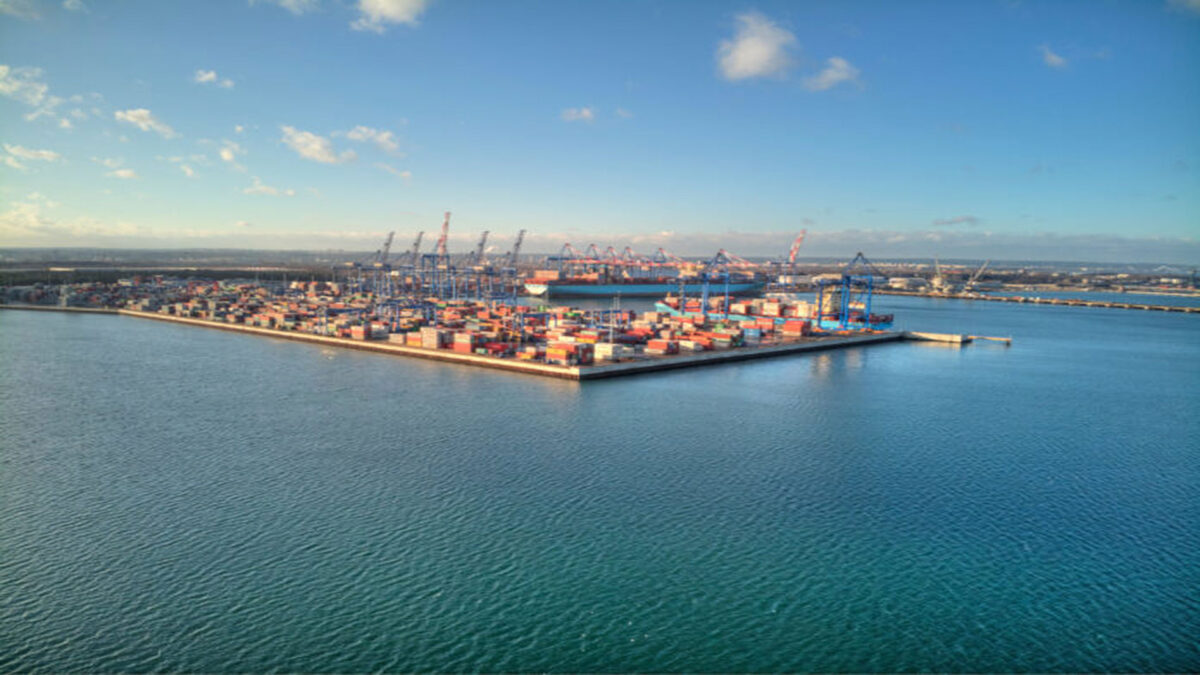
Ulusoy stated that current geopolitical developments should be assessed under two separate contexts, noting that the impacts of the Russia‑Ukraine War and the current US‑Israel‑Iran tensions are not the same. According to him, while the Russia-Ukraine war created a direct supply chain shock across global grain markets, the present tensions are more likely to affect the sector indirectly through energy markets.
“The Russia-Ukraine war caused a direct supply shock to grain markets. What we are witnessing now is more of a supply shock in the global energy chain. Therefore, the impact on the grain sector will not come from supply itself, but rather through energy and cost channels,” he said.
Energy and fertiliser costs could be decisive
Ulusoy noted that developments in energy markets could influence agricultural production costs, highlighting the strategic importance of the Strait of Hormuz for global oil and fertiliser trade.
He pointed out that approximately one-fifth of the world’s oil trade passes through the strait, adding that a significant share of global fertiliser and urea exports also move through the same route.
For this reason, he said, no serious disruption to grain supply is expected in the short term. “The indirect effect will come through costs. Rising energy prices may increase the cost of agricultural inputs, particularly fertilisers. This could shape expectations for the next production season,” he explained.
Demand showing signs of movement
While the supply side currently appears stable in global markets, Ulusoy said there has been noticeable activity on the demand side.
He noted that countries in the Gulf and the Middle East have started to increase their strategic grain stocks due to concerns over food security, which can lead to sudden purchasing activity.
“We discussed the concept of food nationalism during the pandemic and the Russia-Ukraine war. Today we are seeing similar tendencies, with many countries considering increasing their strategic stock levels again. This indicates that demand is likely to remain strong in the short term,” he said.
No supply concerns expected in Türkiye
Ulusoy also underlined that Türkiye maintains a relatively strong supply structure in the grain sector, describing the country as both an importer and exporter.
He noted that Türkiye imports wheat primarily due to its strong flour export industry, while last season’s drought led to a decline in domestic production. Nevertheless, existing stocks and Türkiye’s proximity to Black Sea suppliers helped maintain a balanced market.
“Last season, Türkiye produced around 17.9 million tonnes of wheat and about 6 million tonnes of barley. Despite the drought, there was no supply shortage in the domestic market thanks to carry-over stocks and Türkiye’s proximity to Black Sea supply sources,” he said.
Contraction in the agricultural sector
Ulusoy also noted that Türkiye’s agricultural sector has been significantly affected by adverse weather conditions in recent years, particularly drought and frost.
He said these factors were reflected in economic indicators, pointing out that the agricultural sector contracted by approximately 8.8 percent in the last quarter.
Despite this, expectations for the 2026 season remain positive. According to Ulusoy, Türkiye’s existing stocks and production capacity mean that no major risks to food security are expected in the short term.
Long-term decline in cultivated areas
During the programme, the issue of shrinking agricultural land was also discussed. Ulusoy stated that cultivated areas in Türkiye have declined over the past 20 years, mainly due to demographic changes.
He noted that the decrease in rural population and the ageing of the agricultural workforce represent a challenge not only for Türkiye but for global agriculture as well.
“Over the last two decades, there has been a significant migration from rural areas to cities. The land still exists, but the challenge today is finding farmers who will continue cultivating it. This has become one of the fundamental problems of global agriculture,” he said.
At the same time, he noted that since the pandemic, protecting cultivation areas for strategic crops has become a priority for policymakers. According to field observations, wheat and barley planting areas are expected to increase again in the 2025 season.
Crop shifts across regions
Ulusoy also pointed out that crop patterns are changing in several regions. Due to relatively low cotton prices, farmers in southeastern Türkiye and the Aegean region are shifting from cotton to wheat cultivation.
In the Konya Plain, meanwhile, water management policies are encouraging farmers to switch from maize to wheat and barley.
Changing dynamics in flour exports
The programme also addressed regional changes in Türkiye’s flour export markets. Ulusoy said exports to Iraq, which had long been Türkiye’s largest market, have declined significantly, while exports to Syria have increased rapidly.
Flour exports to Iraq fell from around 1 million tonnes in 2024 to approximately 400,000 tonnes in 2025. In contrast, exports to Syria rose from 320,000 tonnes to 689,000 tonnes, more than doubling over the same period.
He added that Syria now sources more than 80 percent of its flour imports from Türkiye, highlighting the important role of the Turkish flour industry in maintaining food supply chains in the region.